
Football Isn't a Sport Anymore. It's an Asset Class.


An empty stadium is still worth billions
In March 2026, a private equity fund took majority control of Atletico Madrid. In June, a cryptocurrency exchange became an official partner of the FIFA World Cup. And investors are now pricing women's football the way venture capitalists price a Series B startup, not the way anyone prices a mature sports league.
Football did not get more popular this year. It got financialised.
The real story of football in 2026 is not on the pitch. FIFA is running the World Cup like a fund on a four year cash cycle, drawing down reserves in the quiet years and harvesting a record payout in the tournament year. Clubs are being bought less for their squads than for their media rights and the land around their stadiums. Crypto exchanges are buying the trust that gambling companies used to rent. And women's football is being priced on a growth curve steep enough to break a standard valuation model, the same kind of curve that broke my DCF on Zepto a few posts ago.
What is actually happening is that football has become a proxy asset class. Private equity, sovereign wealth, fintech, real estate and venture capital are all using it to price something else. Each section below is one of those industries using football as a mirror.
1. FIFA's four year cash cycle
FIFA is projecting roughly $8.9 billion of revenue from the 2026 World Cup, off an expanded format of 48 teams and 104 matches, against a four year cycle target of $13 billion. Broadcasting is the biggest single line at somewhere between $3.5 and $4 billion. Sponsorship is projected at $2.4 to $2.5 billion, which is up around 37% on 2022. Ticketing and hospitality clear $1 billion, and some estimates put it well above that once dynamic pricing and the controlled resale platform are counted.
That last bit is the part worth pausing on. FIFA is not selling tickets at a fixed price anymore. It is pricing them dynamically and taking a cut of resale through its own platform. That is treating a ticket as a yield instrument rather than a good with a price on it.
But the number that gives the game away is the reserve balance. FIFA's reserves peaked at $3.9 billion after Qatar 2022 and had fallen to $2.7 billion by the end of 2025.
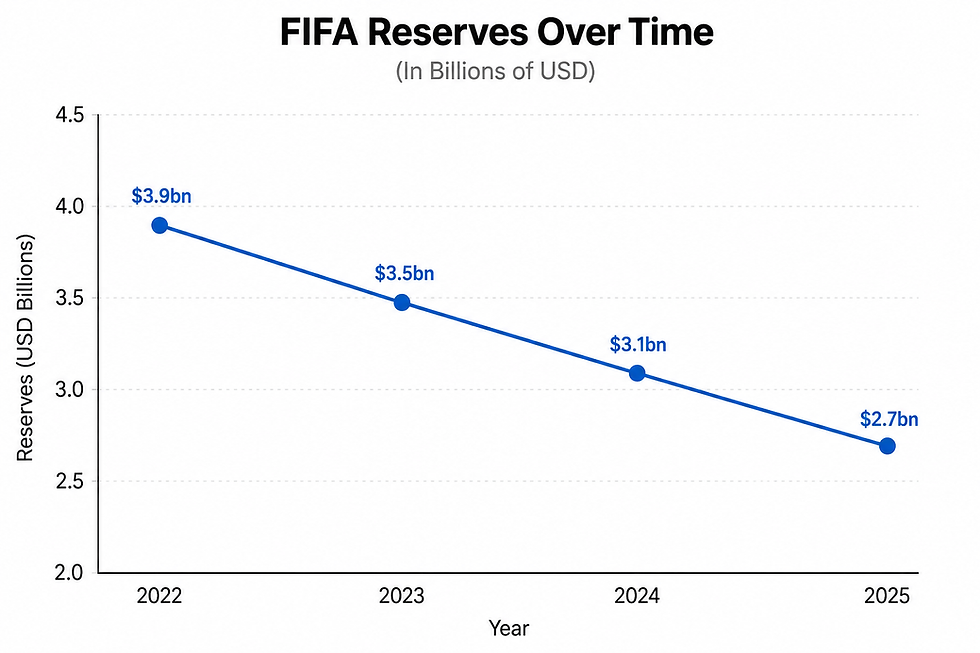
At first glance that looks like decline. It is not. It is a scheduled drawdown. You spend down the balance across the three lean years, then the tournament year refills it. Draw down, then harvest. That is how a fund manages cash across a holding period. It is not how a federation runs an annual budget.
2. What private equity is actually buying
This year's ownership deals, laid out together:

Read down the terms column and the pattern is hard to miss. Infrastructure. Stadium development. Infrastructure again.
It gets more obvious when you look at the funds explicitly backing venues. Arctos and Sixth Street are investing in stadiums for the real estate and district development around them, aiming for revenue on all 365 days of the year through hotels, retail and housing built into the site, rather than just the twenty five or so days a year when there is a match on.

So in most of these deals the football club is the anchor tenant, not the asset being priced. The team fills the seats, the seats justify the planning permission, and the planning permission is where the money is.
The Al Hilal deal is the one I would watch. PIF is not buying a club here, it is selling one, and it has said it plans to offer more clubs to private investors under its 2026 to 2030 mandate. Saudi Arabia is exiting operational ownership of football clubs while keeping the real estate and the hosting rights for 2034. ROSHN Group has reportedly been looking at lease and leaseback structures for the 2034 stadiums, which is a property financing technique, not a sports one. The state has worked out that owning the buildings pays better than owning the teams.
3. Crypto is taking gambling's seat
Kraken is now the Official Crypto Exchange Supporter of the FIFA World Cup 2026, running fan activations across North America and Europe. Financial terms were not disclosed. At club level, Bitpanda is Aston Villa's front of shirt sponsor and zondacrypto sponsors Lechia Gdansk.
Zoom out and total crypto sponsorship deal value in football rebounded to $243 million in the 2024/25 season.

The reason this is happening is regulatory, not cultural. For over a decade gambling companies were football's most reliable sponsorship category, and that money is now retreating. The UK has tightened gambling sponsorship rules, and India's PROG Act banned real money online gaming from May 2026, which removes a large market from the board entirely.
Crypto exchanges are stepping into the exact commercial slot that gambling money is leaving. Same fan base, same regulatory grey zone, same appeal to people who already enjoy taking a position on an uncertain outcome. The only real difference is the marketing, which is now framed around compliance and education rather than odds.
I would treat that as a swap rather than a trend. A whole sponsorship category changed hands.
4. Women's football is being priced like a startup
Deloitte projects global elite women's sports revenue at roughly $3.04 billion in 2026. That is up 25% on $2.4 billion in 2025, and up 340% since 2022. Football and basketball account for about 35% each. The largest single driver is commercial revenue, meaning sponsorship and brand deals, at 45% of total income, which puts it ahead of both matchday and broadcast.
Investors are responding accordingly. Spain's Liga F raised a €55 million private equity round, and NWSL franchise valuations have been climbing fast.
Here is the thing that bothers me about those numbers, and it is the same thing that bothered me when I tried to value Zepto.

A 340% increase over four years is a venture backable curve. It is not a mature league curve. And the moment you try to put a value on something growing like that, you run straight into the terminal value problem. In the Zepto post, the entire valuation came down to one assumption I could not defend with any confidence: what year does this stop compounding at a ridiculous rate and settle into being a normal, single digit growth business? Move that year by three, and the valuation moves by a fortune. The model looked rigorous, but almost all of the output was sitting on that one guess.
Women's football has the same problem, except it is an entire sport rather than one company. Nobody knows whether 2026 is early in the curve or near the top of it. A 25% growth year on top of a 340% four year run could mean the compounding is still going, or it could be the first sign of the slope flattening. Both stories fit the data.
So the honest position is that the growth is real and the valuations are a bet on a date nobody can name yet.
5. Same sport, different machines
Worth putting football next to the leagues it gets compared to.
NFL. Average franchise value sits somewhere around $6.1 to $7.1 billion, with the Dallas Cowboys near $13 billion. That is built on a closed league and something close to a domestic broadcast monopoly. You cannot be relegated and nobody new can join, so a franchise is a permanently scarce object.
NBA. Average franchise value is lower, roughly $4.2 to $5.1 billion, led by the Golden State Warriors at $9 to $10 billion. But it is compounding faster, because its growth story is international reach and a product that works well in short clips on a phone.
IPL. Total business enterprise value hit $20.6 billion in 2026, up 11.4% year on year, according to Houlihan Lokey's 2026 IPL Brand Valuation Study, with standalone brand value at $4.3 billion. The current 2023 to 2027 media rights cycle is worth $6.2 billion. What happens next is genuinely contested: some analysts project 80 to 100% growth in the next cycle, while Media Partners Asia expects a plateau near $5.4 billion, on the grounds that the JioStar merger has removed most of the bidding tension on the buyer side.

That IPL disagreement is the most useful thing in this section, because it shows a growth story getting capped by consolidation among buyers rather than by anything happening in the sport. Ten teams, eighteen years of existence, and the whole league is worth roughly what four or five average NBA franchises are worth. Structure is doing most of the work in that number, not cricket.
Which brings me to football, and the reason the chart above has no football bar. European club football has open promotion and relegation, no salary cap and no closed league scarcity. There is no franchise slot to buy, because there are no franchise slots. That is precisely why private equity is buying individual clubs one at a time, as in section 2, instead of taking a league wide stake the way US and Indian sport allows.
So each of these valuations is really a bet on market structure. Scarcity for the NFL and the IPL. Growth and global reach for the NBA. And for football, real assets and media rights, club by club, because there is nothing league shaped to buy.
Where this leaves things
Five different kinds of money showed up in football this year. Sovereign wealth is rotating out of operating clubs and into land and hosting rights. Private equity is buying stadiums and calling them clubs. Crypto is renting the audience gambling used to rent. Venture style investors are pricing women's football on a curve nobody can date. And the closed leagues are still being valued on scarcity, which football structurally cannot offer.
None of them are really investing in football. They are using football to express a view about something else, whether that is urban property, regulatory arbitrage, a growth market, or the durability of a broadcast monopoly. That is what a proxy asset class is. The sport is the instrument, not the thesis.
One last caveat, and I want to be clear about it rather than bury it. The World Cup revenue figures, the crypto sponsorship totals and everything about the next IPL rights cycle are projections. The tournament has not finished paying out and the next IPL cycle has not been bid. When the real numbers land, some of these will move, and I would rather you be able to see how far off I was than have the post quietly pretend it was always right.

Comments